salakhalimunmountain.com – The forest of Mount Salak and Mount Halimun does not shout directions. It whispers them. If you walk here long enough—through mist-drenched ridges, muddy valleys, and cathedral-like rainforest halls—you begin to understand something important: the forest is not chaos. It is a living system, layered with stories, signs, and rhythms. And local guides don’t just walk through it—they read it.
As we step onto a narrow trail where roots twist like sleeping snakes and the air smells of wet leaves and moss, I often tell visitors this: “Maps are helpful, but the forest itself is the real map.”
In Salak–Halimun, local guides navigate not by domination, but by listening—using terrain, plants, water, sound, light, memory, and feeling. This skill is not learned overnight. It grows slowly, season by season, step by step, until the rainforest becomes familiar like an old friend.
Reading the Land Like a Storybook
Understanding Topography Beneath the Canopy
Before the forest becomes thick, before the trail narrows, a guide already knows where they are standing.
Mount Salak and Mount Halimun are shaped by ridges, valleys, saddles, and drainage lines. Even when the canopy closes above us and the sky disappears, the land still speaks through slope and gravity.
Local guides constantly ask:
- Is the ground pulling us downward?
- Are we walking along a ridge spine?
- Is the valley opening wider, or tightening?
A ridge feels different underfoot—drier, firmer, often with wind brushing the treetops. Valleys collect water, mud, leeches, and cold air. Saddles feel like a breath between climbs.
When we carry a map, we don’t see it as paper. We see it as a three-dimensional body of land, matching contour lines to what our legs and lungs are feeling in real time.
Following Water Like a Trusted Companion
Streams Are the Forest’s Memory
Water never forgets where it is going.
In Salak–Halimun, small trickles often lead to larger streams, which lead to rivers—and rivers often intersect with long-used human paths. Local guides understand this deeply.
When visibility drops because of fog or rain:
- We listen for water before we see it.
- We follow drainage patterns downhill when orientation is unclear.
- We avoid fighting upstream unless there is a known crossing.
Water also tells us about safety. Sudden silence after rain may mean flooding upstream. Heavy cloud buildup in the afternoon often warns us to move with care.
Trees, Plants, and Forest Markers
Nature Leaves Breadcrumbs
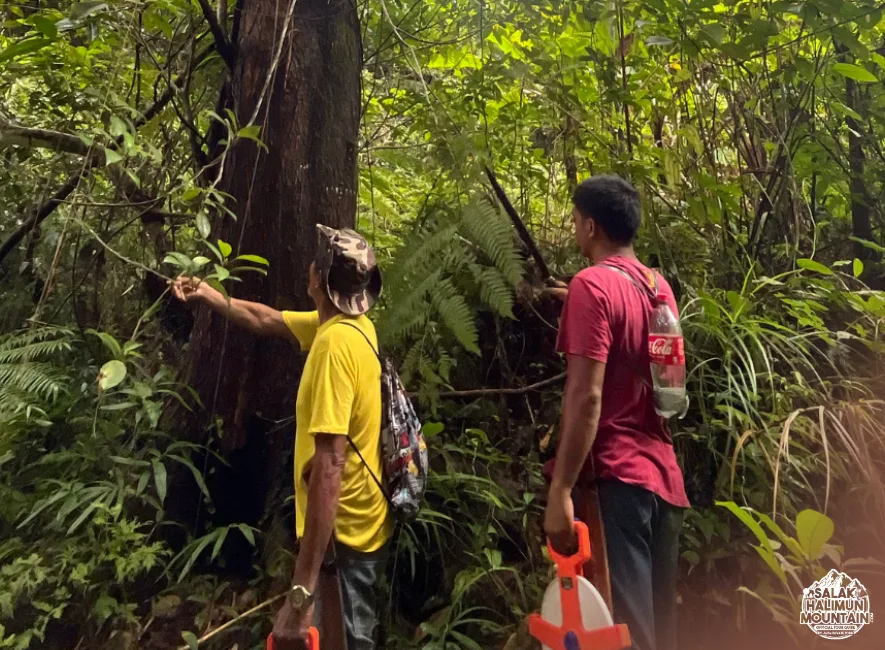
To outsiders, the forest looks uniform—green upon green upon green. But to a local guide, every section of forest has a personality.
Certain trees only grow at specific elevations. Some plants prefer ridgelines, others thrive in damp basins. A sudden change in vegetation often signals a shift in terrain or microclimate.
We also notice:
- Bent or scarred tree trunks where people once passed
- Broken branches at shoulder height
- Old cut marks softened by moss
- Subtle trail depressions hidden beneath leaf litter
These signs may be faint, but they tell us one thing clearly: someone has walked here before.
This is what we call the living map—not written, not fixed, but constantly refreshed by weather, animals, and time.
Reading Light Inside a Dark Forest
Sun Direction Without Seeing the Sun
In dense rainforest, you rarely see the sun directly. But you can feel where it lives.
Morning light enters the forest differently than afternoon light. Moss grows thicker on cooler, damper sides of trees. Even the way shadows stretch tells a story.
Local guides develop a quiet instinct for filtered light, warmth, and the subtle movement of leaves as the sun shifts beyond the canopy.
Listening to the Forest’s Voice
Sound as Navigation
Close your eyes in Salak–Halimun and listen.
Cicadas rise and fall with temperature. Birds call from valley to ridge. Water echoes through stone channels. Wind changes pitch as terrain opens or closes.
Sound travels differently in open spaces than in thick vegetation. A guide uses this to sense distance, direction, and safety beyond sight.
Pace, Foot Feel, and Ground Memory
Letting the Body Learn the Way
Local guides do not march through the forest. We flow with it. Our pace changes instinctively—lighter on slick roots, slower on mud, steadier on rocky climbs. Over time, the soles of our feet memorize the land.
This embodied knowledge is why experienced guides remain calm even when trails fade. The forest still feels right.
Using Tools Without Depending on Them
Compass as Confirmation
Yes, local guides carry compasses. But tools do not lead—they confirm.
We compare compass direction with slope, drainage, and forest structure. In Salak–Halimun, batteries die, signals disappear, and rain humbles devices quickly. The forest remains.
Knowing Weather Before It Arrives
Mount Salak is famous for sudden weather shifts. Local guides watch wind, cloud density, bird behavior, and even changes in smell to anticipate rain and fog.
Routes are chosen not only for distance, but for time and weather rhythm. This protects both visitors and the forest itself.
Forest Knowledge Passed Through Generations
Many local guides grew up beside these forests. Knowledge of plants, animals, and safe passage is passed down through stories, walks, and careful observation.
Reading the forest is not about control—it is about coexistence.
Walking Forward With Respect
Mount Salak and Mount Halimun are not places to conquer. They are places to listen, learn, and move with humility. When you walk with a local guide, the forest begins to speak to you too.
So, if you’re ready to explore the wonders of Mount Salak Halimun, head over to our ONLINE BOOKING PAGE and let’s start planning your adventure.
Or simply CLICK THIS LINK to chat with us on WhatsApp.
With our team, you’re not just getting a guide; you’re gaining a local friend who will ensure your trip is nothing short of extraordinary.